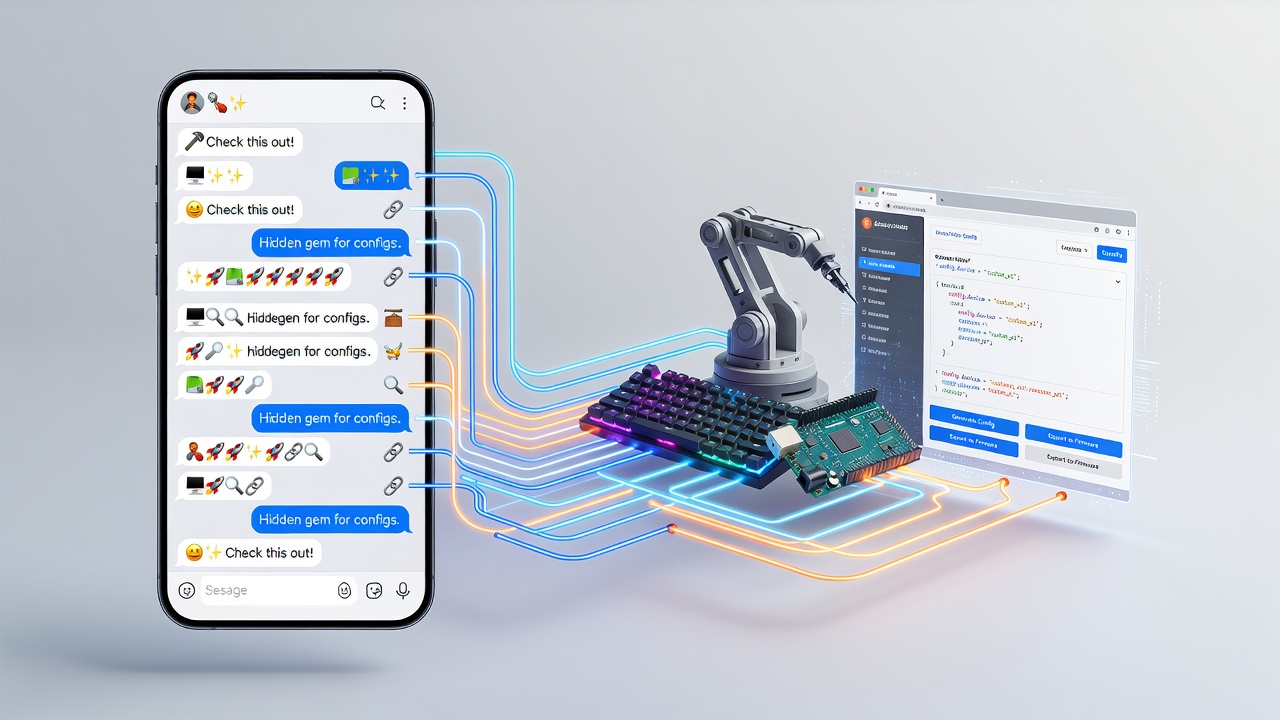
How emoji-coded recommendation chains in messaging apps lead hobbyists to overlooked web tools for custom device configurations
Emoji-coded recommendation chains emerge when users embed sequences of symbols such as 🔧📱⚙️ within group chats on messaging platforms, and these sequences function as shorthand signals that direct participants toward specific web-based utilities designed for device customization. Observers note that the practice gained momentum after October 2026 when several messaging services introduced enhanced emoji reaction features that preserved threaded context across larger participant groups.
Formation of recommendation chains
Users initiate chains by posting an emoji sequence alongside a brief description of a configuration challenge, after which responders reply with additional symbols that refine the original query or introduce related resources. Data from digital interaction studies indicates that such exchanges often span multiple days and involve participants from different time zones who contribute links to lesser-known configuration portals. Researchers at the University of Melbourne documented similar patterns in a 2025 report on collaborative online problem solving, where emoji markers reduced message volume while increasing the precision of shared references.
Chains develop layers when one participant adds a clarifying emoji set that branches the discussion toward firmware adjustment tools or hardware interface scripts. According to figures released by the Australian Bureau of Statistics on digital community engagement, participation in these threaded exchanges increased by 27 percent between 2024 and 2026 among individuals who maintain personal device networks. The structure allows newcomers to trace prior exchanges without reading every prior message, since the emoji markers serve as visual anchors.
Connection to overlooked web tools
Once a chain identifies a particular configuration need, participants frequently reference web tools hosted on independent domains rather than mainstream application stores. These tools often provide granular controls for sensor calibration, network protocol overrides, and custom scripting environments that standard manufacturer software omits. Hobbyists following emoji sequences have located utilities that adjust power management profiles on legacy single-board computers or that remap input mappings for specialized peripherals.

One documented sequence began with the symbols 🛠️🔗 and concluded with a pointer to an open-source configuration dashboard that supports multi-device synchronization across heterogeneous operating systems. European Commission reports on small-scale digital innovation note that such dashboards remain outside major platform indexes, yet they accumulate usage through community referrals rather than algorithmic promotion. The referral process relies on the emoji shorthand to maintain continuity across separate chat instances and different messaging services.
Patterns observed in device configuration communities
Communities focused on custom device setups exhibit recurring emoji vocabularies where 📡 denotes network-level tweaks and 🧩 indicates modular script integration. These vocabularies evolve locally within each group yet share enough overlap to permit cross-community navigation. Statistics Canada data on technology adoption among hobbyist demographics shows that individuals who participate in emoji-mediated exchanges report higher rates of successful integration between discontinued hardware and current subscription services.
Chains sometimes incorporate location-specific symbols that route participants toward regional mirrors of configuration repositories, thereby reducing latency for users accessing scripts during off-peak hours. Academic analyses from the Technical University of Denmark have examined how these location cues interact with emoji sequences to distribute load across multiple hosting providers. The resulting traffic patterns demonstrate that overlooked tools receive sustained visits once embedded within active recommendation threads.
Technical mechanisms supporting chain persistence
Messaging applications preserve emoji sequences within searchable archives, allowing later participants to reconstruct the logic of prior recommendations. Search functions that index both text and emoji characters enable rapid retrieval of configuration resources even when original thread titles omit descriptive keywords. Industry analyses from the Japan Electronics and Information Technology Industries Association highlight that persistent emoji indexing correlates with longer retention of niche utilities within active user bases.
Developers of configuration tools have begun embedding emoji-compatible metadata within their documentation pages, which further accelerates discovery when chains reference those pages. This metadata practice aligns with emerging standards for structured data exchange in collaborative environments, as outlined in guidelines from the International Telecommunication Union. Hobbyists benefit because the metadata ensures that a single emoji reference can surface multiple related resources without requiring repeated clarification messages.
Conclusion
Emoji-coded recommendation chains operate as distributed indexing systems that connect hobbyists with specialized web tools through compact symbolic notation. The mechanisms rely on shared vocabularies, persistent threading, and cross-platform search capabilities that have expanded since October 2026. Available data from multiple national statistical agencies and academic institutions confirms that these chains surface configuration resources that remain outside conventional discovery pathways, thereby supporting ongoing customization of personal and legacy devices.